

Article: Italian craftsmanship today
Italian craftsmanship today
Italian Craftsmanship Today: What Quality Really Means in 2026
From Industrial Production to Conscious Manufacturing: How to Recognize an Authentic Product
In 2026, talking about Italian craftsmanship no longer means looking to the past, but taking a stand in the present. In a system dominated by speed, large-scale production, and standardization, a new appreciation is growing for what is made with skill, time, and genuine intent. More and more people are looking for products that have meaning, that are not just available, but built to last.
In our work, this is not a theoretical concept. Working every day in Milan, in direct contact with those who come into the store, we have seen the questions change: no longer just "how much does it cost," but "how is it made," "how long does it last," "what materials were used." This is where the concept of quality regains concrete meaning.
For us, quality is not a promise. It is the result of a process made of choices, and it is recognized over time, not at the moment a product is purchased.
Handmade is not synonymous with Made in Italy
One of the most common misconceptions concerns the relationship between Made in Italy and craftsmanship. These are two concepts that often overlap but do not coincide.
A product can be made in Italy and follow industrial logic: standardized production, cost optimization, large volumes. This is not necessarily a limitation, but it is important to distinguish it. Craftsmanship, as we understand it, arises when the process is not completely automated and when every stage involves a real decision.
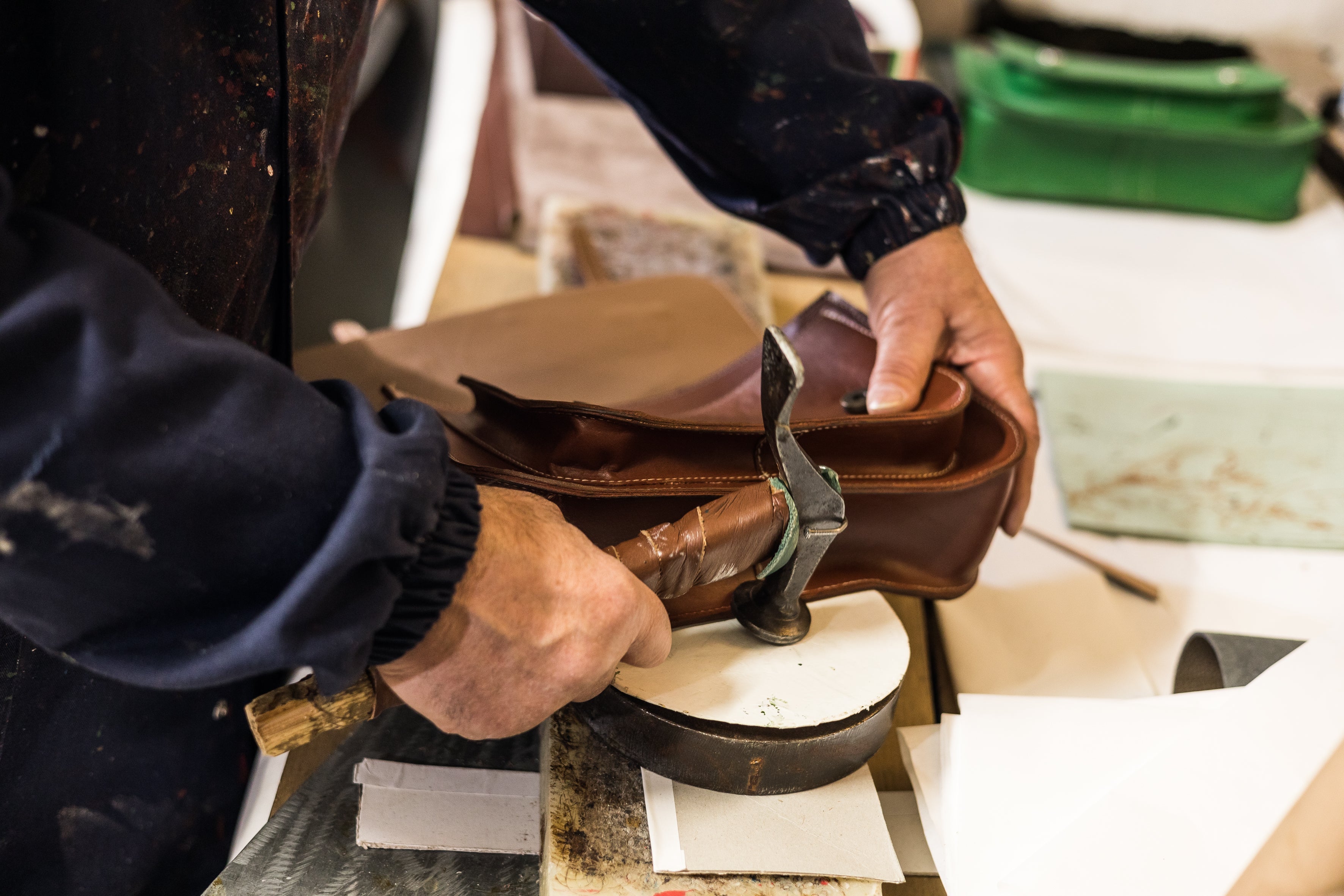
From material selection to construction, we intervene at every step. This means that no two products will ever be perfectly identical, but they will always be consistent with each other. We do not seek perfect replication, but a result that makes sense over time.
Quality is discovered in use, not in appearance
One of the most important aspects we observe every day is the difference between what makes an immediate impression and what endures. Many products are designed to perform well initially: they have a strong visual impact, seemingly high-performance materials, and constructions designed to quickly convince.
But it is in daily use that the differences emerge.
Artisanal quality is recognized in its durability: in the way a bag maintains its shape after months, in the strength of its seams, in the materials' ability to adapt to use without deteriorating. It is a quality that does not need to be explained, because it becomes evident over time.
The invisible details are what make the difference
Much of a product's value is not immediately visible. When we design a bag, we pay a lot of attention to elements that are often not seen but determine everything: the internal structure, reinforcements, weight distribution, and the choice of metal components.
These are aspects that do not show up in a photograph but affect the real experience. This is where the difference is created between a product that works and one that continues to work over time.
Craftsmanship works precisely at this level: less obvious, but decisive.
Produce less, produce better: a concrete choice
In recent years, the way people buy has also changed. More and more people are looking for products that have a logic, that are not the result of excessive or impersonal production.
For us, working in an artisanal way means maintaining control over what we produce, working with more limited quantities, and being able to directly verify the result. Being in Milan and having continuous contact with those who use our products allows us to immediately understand what truly works.
It is not a theoretical choice, but an operational one: it is the only way to maintain consistency between what we design and what is used.
Imperfection as a sign of authenticity
Another element that is often misunderstood concerns the concept of perfection. In the industrial world, quality is associated with identical replication. In craftsmanship, however, quality coincides with the consistency of the result, not with its perfect uniformity.
Small variations between one piece and another are not defects but the natural consequence of a real process. In many cases, they are the most obvious sign that a product has not simply been replicated, but built.
This changes the way one looks at an object: no longer as something standard, but as something with its own identity.
How to recognize artisanal quality
You don't need to be an expert to tell if a product is well-made. Over time, we've seen that a few signals are enough.
An artisanal product is consistent, because materials, design, and price are aligned. It is transparent, because we can always explain how it is made. It is credible, because it does not promise unrealistic performance. And it is solid, in its overall perception, right from the first contact.
We don't try to convince, but to make people understand. The difference, when it exists, is perceptible.
Milan and new contemporary craftsmanship
Milan today is one of the most interesting contexts for observing the evolution of craftsmanship. Not only because of the historical presence of workshops, but also because of the way these realities are transforming.
Working here means dealing every day with international clients, fast rhythms, and high expectations. This has led to the development of a more contemporary craftsmanship, capable of combining tradition, design, and real use.
It is no longer just a matter of manual skill, but of design. And it is precisely this balance that makes Milanese craftsmanship so relevant today.
The real luxury today is choosing better
The concept of luxury has changed. It is no longer just linked to price or immediate recognition, but to the ability to make conscious choices.
Choosing an artisanal product means understanding what you are buying, evaluating the materials, and considering its durability. It means moving from an impulsive purchase to a reasoned choice.
For us, this is the true value today: not having more, but choosing better.
A choice that changes the way we buy
Ultimately, it all boils down to a simple principle. Every product tells the story of how it was made.
Choosing craftsmanship means choosing a more direct, more controlled, more conscious process. It is not necessarily the fastest path, but it is the one that proves to be more solid over time.
And it is precisely in this difference that the true meaning of quality is recognized today.